
How Does Metal Polish Work? The Science Explained
Posted by Flitz Premium Polishing Products on 24th Jul 2024
Ever wondered how metal polish turns a dull, tarnished surface into a brighter, more reflective finish? The answer involves surface chemistry, cleaning, and sometimes changes to the metal's outermost surface.
Metal polish works by helping remove unwanted surface buildup and, depending on the product, refining the surface so it reflects light more evenly. But not every polish works through the same process, and not every dull or damaged surface can be restored simply by polishing it.
In this guide, we'll explain how metal polishing works, what causes oxidation and tarnish, which surface problems polishing may improve, and how to choose an appropriate Flitz product.
What Is Metal Polish and What Does It Do?
Metal polish is a product designed to improve the appearance of suitable metal surfaces. Depending on its formulation, it may help remove tarnish, oxidation, water stains, discoloration, and other surface deposits.
Polishing is different from ordinary cleaning.
Cleaning generally removes unwanted material such as dirt, oil, or loose contaminants. Polishing focuses on improving the appearance of the surface itself, which may involve removing discoloration or refining very small surface irregularities.
A metal can look dull for several reasons:
-
Surface buildup: Oils, fingerprints, dirt, or mineral deposits may cover the original finish.
-
Oxidation and tarnish: Chemical reactions at the surface can create discoloration.
-
Fine surface imperfections: Small irregularities can scatter light instead of reflecting it evenly.
-
Coating deterioration: Damaged lacquer, plating, or other finishes may change the appearance of the underlying metal.
These conditions are not interchangeable. Identifying the cause of dullness helps determine whether a cleaner, metal polish, protectant, or professional refinishing treatment is appropriate.
Explore the Flitz Metal Polishes and Polishing Products collection to compare available options.
How Does Metal Polishing Work?
The science of metal polishing generally involves two processes: removing unwanted material from the surface and improving the way that surface reflects light.
Different formulations accomplish these tasks differently.
Mechanical Polishing and Surface Refinement
Mechanical polishing involves physical contact with a surface. Depending on the materials and equipment used, this action can reduce certain microscopic irregularities and create a more uniform finish.
A smoother surface generally reflects light more consistently, producing a brighter or more mirror-like appearance.
However, the amount of material affected depends on the polishing medium, pressure, technique, and surface.
Some mechanical polishing processes are intended for durable bare metals. Those same techniques may be inappropriate for thin plating, delicate coatings, or intentionally textured finishes.
A shiny result does not automatically mean a surface is undamaged. Aggressive polishing can alter a finish, remove material, or affect decorative details.
Chemical Cleaning and Surface Reactions
Some metal-cleaning and polishing products use chemical processes to help remove unwanted surface compounds.
For example, certain tarnish removers are formulated to act on particular types of discoloration. Other cleaners help loosen or remove residues that interfere with a surface's appearance.
The specific chemistry depends on the formulation and material being treated.
A product intended for silver tarnish, for example, should not automatically be treated as interchangeable with a general-purpose polish for stainless steel or aluminum.
Why Metal Polish Formulations Differ
There is no single formulation shared by all metal polishes.
Products may differ in their cleaning components, polishing media, application consistency, and other ingredients.
These differences influence what the product is designed to accomplish and which surfaces it can be used on.
When evaluating a specific Flitz product, rely on its published application instructions and available product documentation rather than assuming it uses every possible polishing mechanism.
Oxidation, Tarnish, and Corrosion: What's the Difference?
These terms are often used together, but they describe related processes that are not exactly the same.
Oxidation
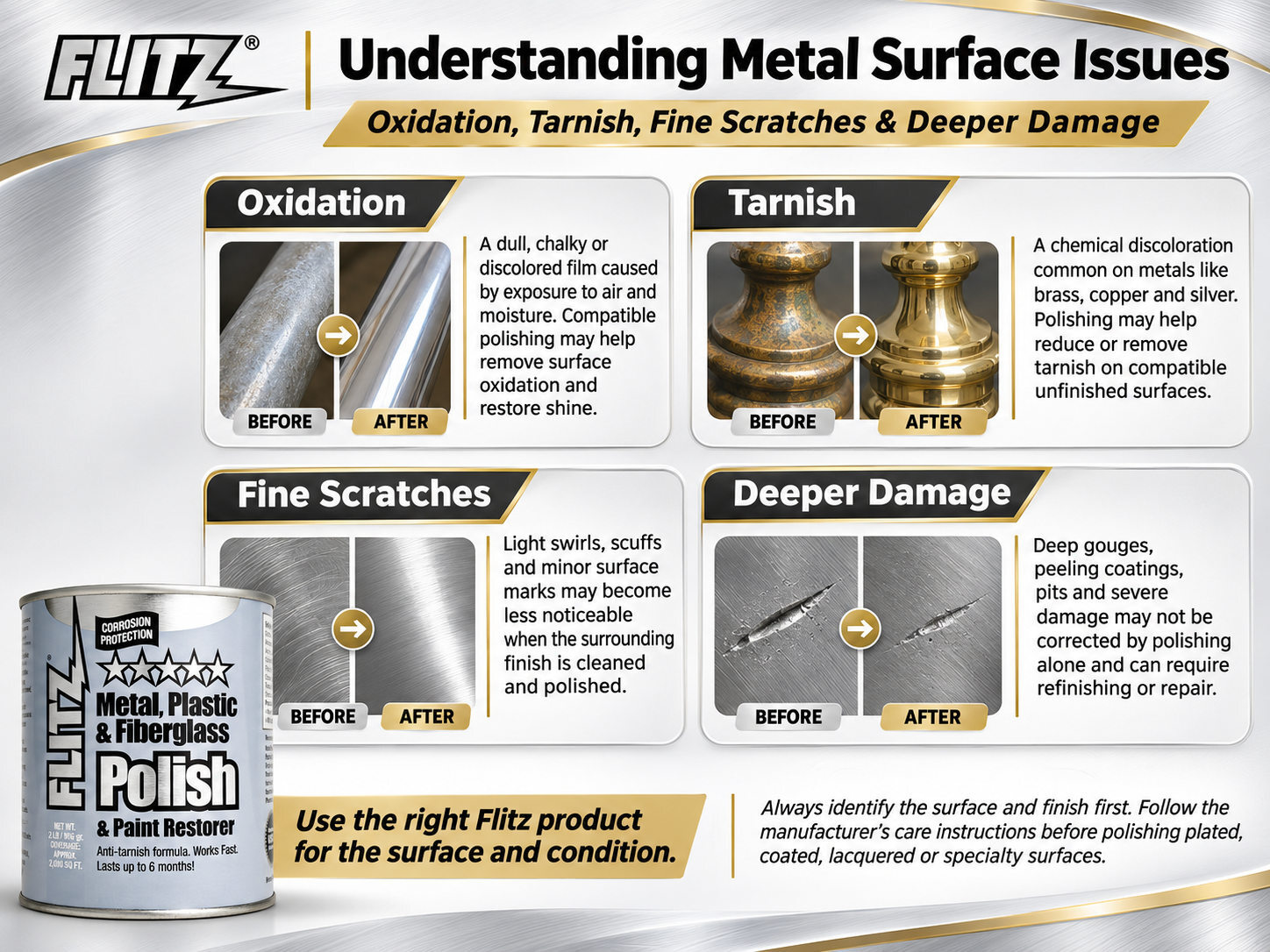
Oxidation is a chemical process involving the loss of electrons. On many metals, it contributes to the formation of surface compounds that affect appearance.
Aluminum, for example, naturally develops an oxide layer. Whether that layer should be disturbed depends on the type of aluminum and the intended finish.
Tarnish
Tarnish is a visible form of surface discoloration caused by chemical reactions.
Silver tarnish commonly involves sulfur-containing compounds, while brass and copper can develop characteristic discoloration as their surfaces react with the environment.
Some tarnish is removable with an appropriate cleaning or polishing product. Other situations require more specialized care.
Corrosion
Corrosion is the deterioration of a material through interaction with its environment.
Light surface corrosion can sometimes be treated without extensive repair. More significant corrosion, pitting, or loss of material cannot necessarily be corrected by polishing.
Polishing can improve the appearance of a suitable surface, but it cannot replace metal that has already been lost to corrosion.
For additional material-specific guidance, read our Guide to Polishing Brass, Copper and Bronze.
Does Metal Polish Remove Scratches?
This is one of the most common questions about metal polishing.
The answer depends on the scratch, the surface, and the particular product.
Very fine surface marks may become less noticeable after an appropriate polishing process. However, a deeper scratch represents physical damage or displaced material, and a polish cannot simply make that missing material reappear.
The following factors matter:
-
Scratch depth: Fine superficial marks differ substantially from deep scratches or gouges.
-
Surface material: Solid metal, chrome plating, clear coat, and plastic behave differently.
-
Existing finish: Matte, brushed, polished, lacquered, and plated surfaces require different methods.
-
Product compatibility: A polish should be used only where the surface and product instructions permit it.
-
Technique: Excessive pressure or unsuitable tools can create additional damage.
For a more detailed discussion, see our Guide to Removing Scratches from Stainless Steel, Aluminum, Glass, Car Paint and Plastic.
The goal is to improve the finish without causing additional surface damage.
What Is Metal Polish Made Of?
Metal polishes do not all contain the same ingredients.
Depending on their intended use, different commercial formulations may include cleaning agents, polishing materials, carriers, stabilizers, and other components.
The presence and concentration of those materials vary by product.
For that reason, explaining the general chemistry of metal polish is different from describing the exact ingredients of one manufacturer's proprietary formula.
What Is Flitz Polish Made Of?
Flitz offers multiple cleaning, polishing, and protection products. Their formulations and intended applications are not necessarily identical.
The published Flitz Paste Metal Polish product page provides product information and links to supporting documents, including its Safety Data Sheet and ingredient disclosures.
Safety Data Sheets provide important safety and handling information, but they should not automatically be interpreted as complete proprietary recipes.
When researching Flitz polish ingredients, consult the documentation for the exact product and current formulation.
We should not assume that every Flitz polish contains particular polishing particles, solvents, acids, or polymers unless that information is specifically supported by its documentation.
What Is Flitz Polish Used For?
Flitz offers polishing products designed for a variety of compatible materials and cleaning applications.
Two of the main options are:
A concentrated polishing cream intended for suitable metal and other approved surfaces. Its product documentation describes applications involving tarnish, oxidation, discoloration, water stains, and surface buildup.
A liquid-format polish that can be easier to spread across larger areas or used for regular maintenance of compatible surfaces.
Applications described in Flitz product information include certain aluminum, brass, copper, chrome, stainless steel, and other material-specific projects.
However, compatibility depends on the exact surface and finish.
Plated surfaces, matte finishes, protective coatings, specialty paints, and delicate materials may require different products or should not be polished at all.
Always review the specific product instructions before application.
Metal Polish vs. Tarnish Remover vs. Protectant
Although these products can be used during related surface-care projects, they serve different purposes.
Metal Polish
A metal polish is intended to improve the appearance of compatible surfaces, including certain types of tarnish, oxidation, and discoloration.
Some polishing products also provide a protective benefit, depending on their formulation.
Specialty Tarnish Remover
A specialty tarnish remover is formulated for particular types of discoloration and materials.
Its cleaning mechanism and application requirements may differ from those of a general-purpose metal polish.
A product designed to remove tarnish from one metal should not automatically be applied to other metals, plated surfaces, or delicate finishes.
Surface Protectant
A protectant is generally selected to help maintain a compatible surface after appropriate cleaning or preparation.
Protectants, waxes, and sealants have different formulations and application requirements. They do not necessarily remove existing oxidation or correct surface imperfections.
For protection options, explore Flitz Surface Protectants, Waxes and Sealants.
The best surface-care routine depends on what the material actually needs. Some projects involve cleaning only, while others may call for polishing followed by a separate protective treatment.
Paste vs. Liquid Metal Polish: What's the Difference?
Flitz offers paste and liquid polishing products for different applications and preferences.
According to Flitz's published product guidance, the paste is more concentrated, while the liquid consistency can make application across larger surfaces easier.
Flitz also identifies differences in their protective characteristics.
That doesn't mean the two formats should be assumed identical in ingredients or interchangeable for every application.
For a closer comparison, read Flitz Liquid Polish vs. Flitz Paste Polish: A Comprehensive Guide.
If you already have a compatible surface and want practical application instructions, see Mastering Metal Polishing with Flitz Paste Metal Polish.
When Should You Avoid Polishing a Surface?
Not every surface benefits from polishing.
Before choosing a metal polish, consider whether the material has an intentional finish that could be altered.
Examples requiring extra caution include:
-
Lacquered or painted surfaces: The coating may require a finish-specific care product.
-
Plated metal: Thin or delicate plating may be affected by polishing.
-
Brushed or matte finishes: Polishing may create unwanted shiny areas or change the original texture.
-
Anodized aluminum: Its engineered surface finish requires material-specific care.
-
Antiques and collectibles: Natural patina may contribute to the item's appearance and value.
-
Deeply corroded or damaged metal: Repair or refinishing may be necessary before cosmetic polishing.
When in doubt, consult the surface manufacturer's care instructions and verify product compatibility.
Testing a small, inconspicuous area is a useful precaution where testing is permitted, but it does not replace proper compatibility guidance.
Metal Polishing Science FAQs
How does metal polish work?
Metal polish helps improve the appearance of compatible surfaces by removing certain contaminants, tarnish, or oxidation and, depending on its formulation, refining the outermost surface. The exact process varies by product.
How does Flitz polish work?
Flitz Paste and Liquid Metal Polishes are formulated to clean and polish compatible surfaces. Their published product information describes applications such as removing tarnish, oxidation, stains, and discoloration. Specific chemical mechanisms should be described only when supported by the exact product's technical documentation.
Is metal polishing a chemical or mechanical process?
It can involve chemical processes, physical surface refinement, or a combination, depending on the product and technique. Not all formulations work the same way.
What ingredients are in Flitz polish?
Refer to the ingredient disclosures and safety documentation available for the specific Flitz product. A general description of metal-polishing ingredients should not be mistaken for the complete Flitz formula.
Does metal polish remove oxidation?
Appropriate products can help remove certain types of surface oxidation on compatible materials. Severe corrosion, pitting, or damaged coatings may require a different treatment.
Can metal polish remove scratches?
Some fine surface marks may become less noticeable after suitable polishing. Deep scratches, missing material, and damaged plating cannot necessarily be restored with polish alone.
Is metal polish the same as tarnish remover?
No. Metal polishes and dedicated tarnish removers can have different formulations, intended materials, and application methods.
Does polishing prevent future oxidation?
Polishing alone should not be assumed to provide lasting protection. Some products include protective properties, while other projects may call for a separate wax or sealant. Follow the exact product's documentation.
Can you use the same polish on coated and bare metal?
Not automatically. Bare metal, lacquer, plating, paint, and specialty coatings may have different compatibility requirements. Always identify the finish before polishing.
Understanding the Science Behind the Shine
The science of metal polishing is more than simply making a surface look shiny.
It involves understanding what has changed on the surface, whether the issue is dirt, tarnish, oxidation, fine imperfections, or deeper damage, and choosing a suitable treatment.
Flitz offers products for cleaning, polishing, and protecting a range of compatible surfaces, but successful results begin with identifying the material and following the correct instructions.
Understand the surface. Choose the right product. Clean, polish, and protect where appropriate.
Explore the complete Flitz Polishing Products Collection to find the right option for your project.