
Knife Care That Pays Off: How to Polish a Knife for Extended Life
Posted by Flitz Premium Polishing Products on 9th Jul 2026
If you own a knife, you should know how to polish it. A good, professional knife is an investment. Hunting blades, tactical folders, and collectible pieces all deserve proper care. Careful maintenance means the difference between a life that lasts a little while and one that can last a lifetime.
Proper knife care isn’t a complicated task. You don’t need professional tools or specialized equipment. What you really need is the right products and a regular routine, so knife maintenance becomes second nature.
Key Takeaways
- Polishing is part of knife maintenance and protection. It removes residue, tarnish, and oxidation.
- A sharp blade is a safe blade. Dull edges require more force and less control.
- Polishing and protecting work together for lasting knife care.
- Storage can undo your hard work. Remember, moisture management is crucial.
Why Knife Polishing Is About More Than Appearance
When you own a tactical or collectible knife, you need to know how to polish it properly. Knives can last generations, but polishing matters beyond just keeping them looking nice. Polishing also prevents rust and corrosion before it starts. Storage is also essential because even the best polishing and maintenance can be undone by improper storage.
When you think of polishing your knife, you probably think about shine. And for a good reason—a bright, shiny blade looks much better than a dull, oxidized one. But the benefits go beyond aesthetics.
Polishing removes the accumulation that can lead to corrosion on a knife. Residue from regular use, like oils from your hands, mineral deposits from water, or organic matter from the field, can damage the surface. Dirty conditions accelerate rust and corrosion, especially when you introduce moisture in the mix. Regular polishing is essential for removing deposits and grime before they cause damage.
A clean blade also maintains an edge for longer. Debris and mineral deposits dull the cutting surface over time because uneven buildup impacts the way a blade performs on contact. Knife polishing removes the buildup and keeps the edge sharp.
Polishing extends the life of the metal because surface corrosion doesn’t just stay on the surface. When it’s left unaddressed, the oxidation works deeper into the metal, causing pitting and structural degradation that often can’t be reversed. Keeping up a consistent polishing and maintenance routine helps you stop the process before it becomes an issue.
If you own a tactical knife, polishing is part of maintenance, not just vanity. A knife you polish regularly will outlast others by years, sometimes even decades.
How to Polish a Knife with Flitz Products
When you’re ready to shine up your knife, reach for the right polish. It can make a big difference in the process, as well as the result. Flitz Liquid Metal Polish is formulated to work on stainless steel, brass, copper, titanium, and most other knife blade materials.
Harsh cleaners and polishes physically scrub the knife’s surface, removing metal along with the residue. Flitz, on the other hand, lifts oxidation, tarnish, and surface deposits without scratching and wearing down your blade.
Flitz also gives you durable protection. Your blade will stay sharp for up to six months in freshwater environments, and up to three months in saltwater, making it excellent for hunters, anglers, and anyone who uses their knife outdoors.
Fortunately, the polishing process is simple. Follow these steps to get a gleaming blade.
How to Polish a Knife:
- Clean the blade first. Before you start to polish, make sure that the blade is free of any loose dirt, debris, or organic residue. Wipe the blade with a clean cloth to remove surface contaminants. Polishing a dirty blade can push debris across the surface, rather than removing it.
- Apply a small amount of Flitz Liquid Metal Polish directly to the blade. A little Flitz goes a long way. Our Liquid Metal Polish is concentrated, so you don’t need much to start. Apply a small amount to the blade, working it in with your finger using circular motions for even surface coverage. Pay close attention to areas where the knife shows signs of tarnish or oxidation.
- Buff with a microfiber cloth. Reach for a quality microfiber cloth to help you buff away the polish. Work in the direction of the grain, whenever possible. Our Flitz Microfiber Polishing Cloths use microfiber technology to pick up polish residue without leaving behind lint, product, or streaks. No waiting time is required. Flitz is ready to buff immediately.
- Repeat as needed. For blades that show a significant amount of oxidation or tarnish, a second application may be needed. Work through any discolored areas with a second pass before you buff the knife to a clean finish.
Blade Maintenance: Sharpening
Polishing takes care of your blade’s surface, but to take care of the edge, you need sharpening too. Both actions should be part of your maintenance routine.
Remember, sharp blades are safer blades. While it may sound a little counterintuitive, basic physics tells us why. A dull blade requires more force to cut, which puts more pressure on your grip and gives you less control over the cut. Most knife injuries happen with dull blades, not sharp ones. Keeping the edge of your knife maintained reduces the force you need to use the knife and keeps you in control.
Our Flitz Knife Restoration Kit includes a DMT Dia-Sharp® diamond sharpener. It offers fast, professional sharpening on small contact areas and pointed tools. It’s ideal for hunting and tactical knives. Diamond sharpening is fast, consistent, and can be done dry or with water. It helps you maintain your blade’s edge without grinding it away.
A few guidelines for effective knife sharpening:
- Maintain a consistent 15–20-degree angle on each side.
- Use light, consistent pressure.
- Sharpen before the blade is dull, if possible.
- Keep up with light, frequent sharpening.
- Finish with a leather strop or light polish for a clean edge.
Stopping Rust and Corrosion on Your Blade
Polishing helps you take off corrosion and residue that can mar your blade, but a protective sealant actually prevents that damage from coming back. The two steps work together to protect your blade.
Flitz Gun & Knife Ceramic Sealant creates a hydrophobic, nanoceramic finish. Sealant protects and prevents future rust formation. A light application helps ensure that your polishing and sharpening work for the long haul. Without leaving behind film or hard-to-remove residue.
It’s especially critical to protect knives used in wet environments. Fishing, hunting, and field conditions can expose your knife to damaging moisture, which leads to rust. When your blade is protected, it sheds water, rather than holding against the metal.
What Most Knife Owners Get Wrong About Proper Storage
Even if you perfectly maintain your knife, proper storage is critical for avoiding problems. Moisture—the biggest threat—can do serious damage if it’s trapped against the blade with nowhere to go.
There are a few rules of knife storage that can help you protect your blade:
- Never store your knife in a leather sheath long-term. Leather retains moisture and holds it against the blade. A sheath is fine for everyday carry, but for extended storage, remove the knife from the sheath.
- Control moisture actively. If you’re storing a knife in a case, bag, or drawer for an extended period of time, add a desiccant (silica gel) packet to absorb the moisture. This simple, cheap solution prevents the slow, invisible moisture damage that can occur in even seemingly dry environments.
Consider airtight storage. For long-term storage, collectibles, backup blades, or pieces you rotate seasonally, wrap them with acid-free packing paper and seal in an airtight bag with a desiccant packet for the most reliable protection from damage.
Store in a place with consistent temperatures. Extreme temperature changes and fluctuations lead to condensation, which deposits moisture directly on the blade. So, it’s best to keep knives in a space without considerable temperature fluctuations.
The Flitz Knife Restoration Kit: For a Simple Knife Maintenance Routine
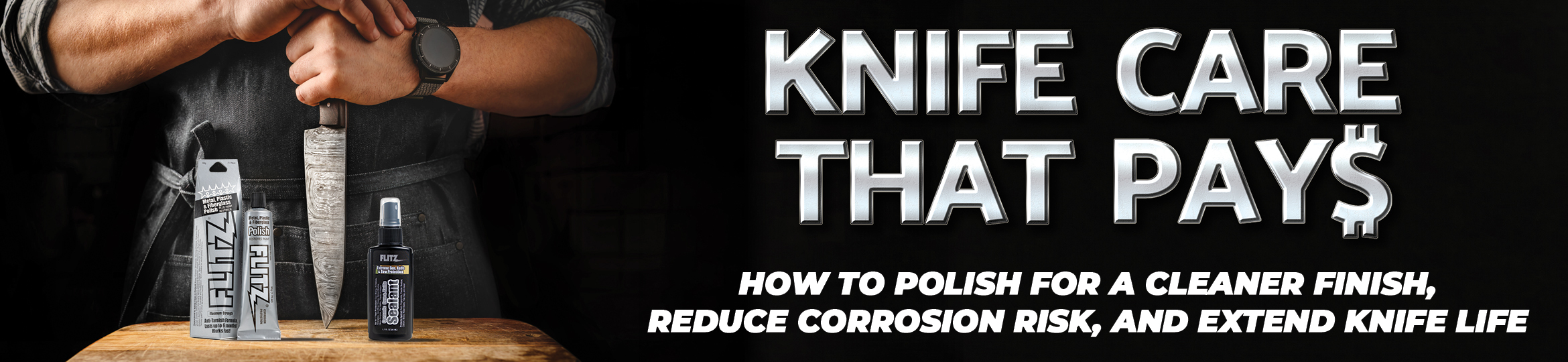
You could source individual products for your knife care and maintenance, but our Flitz Knife Restoration Kit brings together everything covered in this guide. You get Flitz Liquid Metal Polish, the sharpener, a microfiber cloth, and Ceramic Gun & Knife Sealant in a convenient all-in-one kit.
You have your complete maintenance routine to cover the full job of restoration and protection. If you’re deciding on a knife maintenance routine, the Flitz Knife Restoration Kit is the perfect answer.
Remember that the best knife maintenance routine is the one you’ll actually stick to:
- After use: wipe the blade clean to remove debris, moisture, and organic residue.
- Monthly to seasonally: Polish with Flitz Liquid Metal Polish to remove oxidation and tarnish. Sharpen the blade and protect it with Ceramic Gun and Knife Sealant. Dry and buff thoroughly.
- Should you need to store your knife: Clean, polish, protect, and then store it in a moisture-controlled environment.
That’s the complete knife care routine. It takes just a few minutes, but you get a reliable, sharp, clean, functional blade. Extend the life of your knife for decades with proper upkeep.
A good knife deserves good care. The Flitz Knife Restoration Kit makes that easy.